Un mite que tothom coneix i quasi ningú no llegeix, i el que hi vam trobar.
El mite d'Ariadna
Ariadna era filla de Minos i Pasífae i, per tant, princesa de Creta. El rei Minos va sotmetre Atenes després que un fill seu, Androgeu, hi hagués mort assassinat. Va obligar els atenencs a pagar un tribut: cada nou anys enviarien un grup de catorze joves, que serien sacrificats al Minotaure, tancat en un laberint tan ben fet que ni Dèdal, que el va construir, sabia sortir-ne.
Un cop, en una d'aquestes trameses de nois, hi va anar, voluntàriament, el príncep Teseu, fill del rei d'Atenes. Teseu, arribat a Creta, va enlluernar Ariadna, que se'n va enamorar. Assessorada per Dèdal, li va donar una espasa màgica, amb la qual podria matar el Minotaure, i un fil de llana que no es podia trencar, que l'ajudaria a trobar el camí de sortida del laberint.
"Agafa aquest cabdell, lliga'l a la porta i deixa'l anar mentre avances."
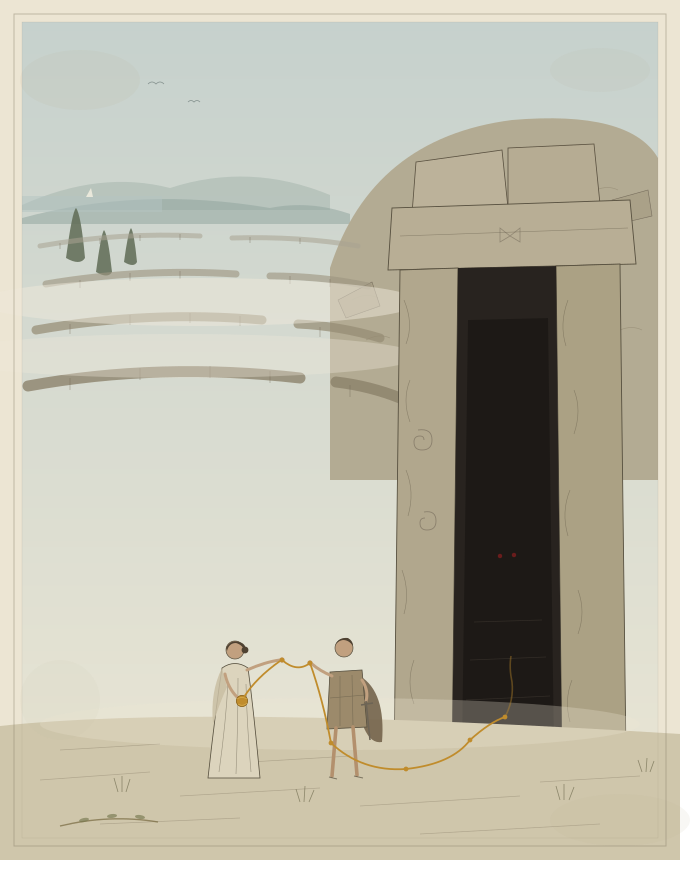
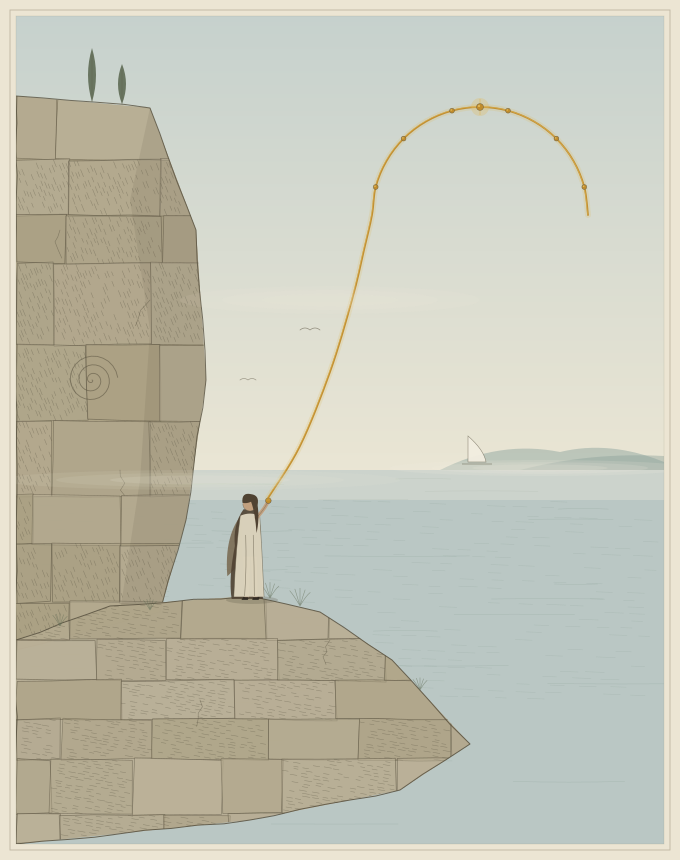
Al llindar del laberint. El fil es lliga a la porta i té nusos: cada nus és un pas que es pot citar. Il·lustració de MotherHacker per a la sèrie ARIADNA-KGCS.
Teseu entra, mata el Minotaure, torna resseguint el fil i surt. Els enamorats fugen junts. A l'illa de Naxos, Teseu marxa mentre ella dorm. Dionís la troba a la platja, i quan Ariadna mor, la seva corona puja al cel: la Corona Boreal.
Dins del laberint
Dins, res no es distingeix de res. Els passadissos són tots iguals, cada revolt en du dos més, i no hi ha cap punt de referència que serveixi per saber si s'avança o es torna enrere. Teseu hi entra amb el fil lligat a la llinda i passant-li per les mans; a cada bifurcació ha de triar, i a cada pas el fil s'estén una mica més darrere seu. Mentre camina, el fil fa dues feines: li diu per on ha passat i, per la seva absència, per on encara no.
Aquí el mite calla, i nosaltres hi posem una imatge perquè és la que fa entendre la resta: imagineu que el fil s'il·lumina mentre Teseu va pel bon camí. Cada tram que el duu una mica més a prop del centre brilla; quan agafa un passadís que no porta enlloc, la llum s'apaga. No és màgia, és una comprovació a cada pas: Teseu no s'ha de refiar de la intuïció ni d'un «deu ser per aquí», només mirar si el fil continua encès. I quan s'apaga, no cal discutir-ho: desfà els passos fins al darrer nus, l'últim punt on sap del cert que encara anava bé, i prova l'altre braç.
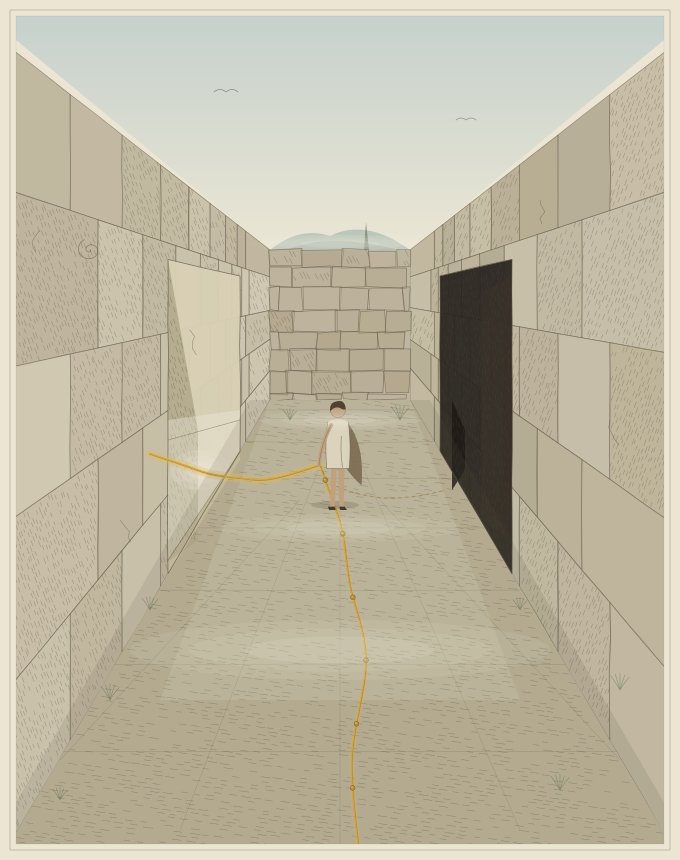
La bifurcació. El fil s'il·lumina cap al camí bo i s'apaga cap a la foscor. Il·lustració de MotherHacker per a la sèrie ARIADNA-KGCS.
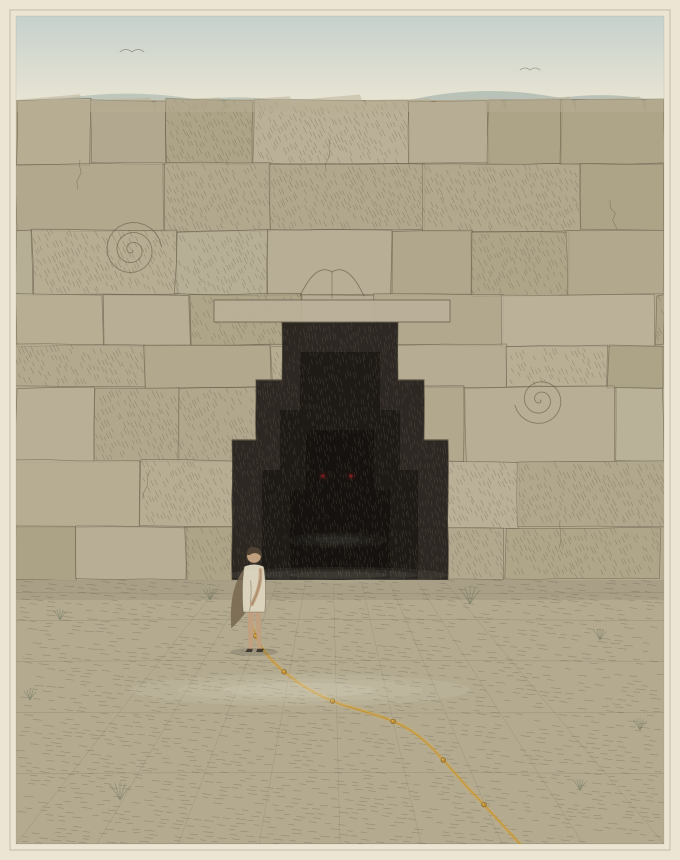
Al centre, a la foscor, hi ha el Minotaure: a la il·lustració, només dos punts vermells. Teseu el mata i torna com ha vingut, resseguint el fil, pas a pas i pels mateixos revolts, fins a la llinda, on Ariadna l'espera. El camí de tornada no l'ha hagut d'inventar: era el mateix, recorregut a l'inrevés.
La porta del centre. El fil acaba a la mà; al davant, només dos punts vermells. Il·lustració de MotherHacker per a la sèrie ARIADNA-KGCS.
El que se sol passar per alt
La lectura habitual es queda amb el fil i el fa màgic, el gadget de l'heroi; i amb Ariadna com a ajudant enamorada. Les dues coses són al text. Cap de les dues és el que el text explica.
Ariadna no entra al laberint. Coneix el palau perquè hi ha viscut al costat, però qui camina és Teseu. Ella es queda a la llinda. El coneixement i l'acció estan en dues persones diferents, i el mite funciona justament perquè ho estan.
El fil es lliga a la porta. No es teixeix a dins mentre Teseu avança: existia abans que entrés i continua existint quan en surt. Teseu no crea el camí de tornada; el descobreix, perquè hi ha una cosa fixa que el connecta amb la sortida. La força del fil és que no depèn del laberint.
El fil té dues puntes i, entremig, el recorregut sencer, pas a pas. Si Teseu hagués volgut una drecera (tallar el fil i fer via recta), s'hauria perdut. Es pot tornar perquè el camí és el mateix a l'anada i a la tornada.
A Naxos, el fil es queda. Teseu marxa; el que queda es pot tornar a fer servir. I la corona que puja al cel és el que serveix per orientar-se quan la història ja s'ha acabat.
Naxos. Teseu marxa; el fil es queda i puja al cel fet corona. Il·lustració de MotherHacker per a la sèrie ARIADNA-KGCS.
Llegit així, el mite no va d'un heroi amb un gadget. Va de com es pot sortir d'un lloc que ningú no coneix sencer, si hi ha una cosa fixa lligada a la porta i es pot resseguir salt a salt.
El primer projecte
Un centre d'operacions de seguretat és un laberint que ningú no coneix sencer. I els assistents d'IA que hi entren ho fan com Teseu sense fil: responen bé, sonen bé, i no hi ha manera de saber quina part han llegit i quina han completat perquè encaixava.
El primer projecte de la comunitat és aquest fil, lligat a la porta: un graf de ciberseguretat, construït amb els estàndards públics, amb una sola regla per als agents d'IA que hi treballin: prohibit inventar. Un identificador que no valida, no existeix. Un camí que no passa per l'evidència, no existeix. Una resposta sense origen, no existeix. Si una resposta no pot dir per on ha passat, no és una resposta. El camí és determinista; la resposta, auditable per qualsevol.
Es diu Ariadna. El que porta a dins es diu KGCS. I amagat a la vista: AR·IA·DNA.
— Laia Cabot
The myth
A classic, interpreted by MotherHacker
A myth everyone knows and almost nobody reads, and what we found in it.
The myth of Ariadne
Ariadne was the daughter of Minos and Pasiphaë and therefore a princess of Crete. King Minos had subdued Athens after one of his sons, Androgeus, was killed there. He forced the Athenians to pay a tribute: every nine years they would send a group of fourteen young people, to be sacrificed to the Minotaur, locked in a labyrinth so well built that not even Daedalus, who made it, could find his way out.
Once, among one of these shipments of youths, Prince Theseus, son of the king of Athens, went of his own free will. Having arrived in Crete, Theseus dazzled Ariadne, who fell in love with him. Advised by Daedalus, she gave him a magic sword, with which he could kill the Minotaur, and a thread of wool that could not be broken, which would help him find the way out of the labyrinth.
"Take this ball, tie it to the door and let it run as you go."
Theseus enters, kills the Minotaur, follows the thread back and comes out. The lovers flee together. On the island of Naxos, Theseus leaves while she sleeps. Dionysus finds her on the beach, and when Ariadne dies, her crown rises to the sky: the Corona Borealis.
The threshold of the labyrinth. The thread is tied to the door and has knots: each knot is a step that can be cited. Illustration by MotherHacker for the ARIADNA-KGCS series.
Inside the labyrinth
Inside, nothing tells one thing from another. The corridors are all alike, every turn opens onto two more, and there is no landmark to say whether you are moving forward or going back. Theseus goes in with the thread tied to the lintel and running through his hands; at every fork he has to choose, and with every step the thread pays out a little further behind him. As he walks, the thread does two jobs: it tells him where he has been and, by its absence, where he has not.
Here the myth is silent, and we add an image because it is the one that makes the rest make sense: imagine the thread lights up while Theseus is on the right path. Every stretch that brings him a little closer to the centre glows; when he takes a corridor that leads nowhere, the light goes out. It is not magic, it is a check at every step: Theseus does not have to trust his instinct or a hunch that it must be this way, only look at whether the thread is still lit. And when it goes dark, there is nothing to argue about: he undoes his steps back to the last knot, the last point where he knows for certain he was still on track, and tries the other branch.
The fork. The thread lights up towards the right path and goes dark towards the dark. Illustration by MotherHacker for the ARIADNA-KGCS series.
At the centre, in the dark, is the Minotaur: in the illustration, just two red dots. Theseus kills it and goes back the way he came, following the thread, step by step and through the same turns, all the way to the lintel, where Ariadne is waiting. He did not have to invent the way back: it was the same path, walked in the opposite direction.
The door at the centre. The thread ends at his hand; ahead, only two red dots. Illustration by MotherHacker for the ARIADNA-KGCS series.
What usually goes unnoticed
The usual reading keeps the thread and makes it magic, the hero's gadget; and keeps Ariadne as the helper in love. Both are in the text. Neither is what the text is about.
Ariadne does not enter the labyrinth. She knows the palace because she has lived beside it, but Theseus is the one who walks. She stays at the threshold. Knowledge and action sit in two different people, and the myth works precisely because they do.
The thread is tied to the door. It is not woven inside as Theseus advances: it existed before he entered and it is still there when he leaves. Theseus does not create the way back; he discovers it, because something fixed connects him to the exit. The thread's strength is that it does not depend on the labyrinth.
The thread has two ends and, in between, the whole path, step by step. Had Theseus wanted a shortcut (cut the thread and go straight), he would have been lost. The way back is possible because the path is the same going in and coming out.
At Naxos, the thread stays. Theseus leaves; what remains can be used again. And the crown that rises to the sky is what you steer by once the story is over.
Naxos. Theseus leaves; the thread stays and rises to the sky as a crown. Illustration by MotherHacker for the ARIADNA-KGCS series.
Read this way, the myth is not about a hero with a gadget. It is about how to get out of a place nobody knows in full, when something fixed is tied to the door and can be followed hop by hop.
The first project
A security operations centre is a labyrinth nobody knows in full. And the AI assistants that walk into it do so like Theseus without a thread: they answer well, they sound right, and there is no way to tell which part they read and which part they filled in because it fit.
The community's first project is that thread, tied to the door: a cybersecurity knowledge graph built from the public standards, with a single rule for the AI agents that work on it: no inventing. An identifier that does not validate does not exist. A path that does not go through the evidence does not exist. An answer without an origin does not exist. If an answer cannot say where it walked, it is not an answer. The path is deterministic; the answer, auditable by anyone.
It is called Ariadna. What it carries inside is called KGCS. And hidden in plain sight: AR·IA·DNA.
— Laia Cabot
El mito
Un clásico interpretado por MotherHacker
Un mito que todo el mundo conoce y casi nadie lee, y lo que encontramos en él.
El mito de Ariadna
Ariadna era hija de Minos y Pasífae y, por tanto, princesa de Creta. El rey Minos sometió a Atenas después de que un hijo suyo, Androgeo, muriera asesinado allí. Obligó a los atenienses a pagar un tributo: cada nueve años enviarían a un grupo de catorce jóvenes, que serían sacrificados al Minotauro, encerrado en un laberinto tan bien hecho que ni Dédalo, que lo construyó, sabía salir de él.
Una vez, en uno de esos envíos de jóvenes, fue voluntariamente el príncipe Teseo, hijo del rey de Atenas. Teseo, al llegar a Creta, deslumbró a Ariadna, que se enamoró de él. Aconsejada por Dédalo, le dio una espada mágica, con la que podría matar al Minotauro, y un hilo de lana que no se podía romper, que le ayudaría a encontrar la salida del laberinto.
"Coge este ovillo, átalo a la puerta y suéltalo mientras avanzas."
Teseo entra, mata al Minotauro, vuelve siguiendo el hilo y sale. Los enamorados huyen juntos. En la isla de Naxos, Teseo se va mientras ella duerme. Dioniso la encuentra en la playa, y cuando Ariadna muere, su corona sube al cielo: la Corona Boreal.
El umbral del laberinto. El hilo se ata a la puerta y tiene nudos: cada nudo es un paso que se puede citar. Ilustración de MotherHacker para la serie ARIADNA-KGCS.
Dentro del laberinto
Dentro, nada se distingue de nada. Los pasillos son todos iguales, cada recodo abre dos más, y no hay ningún punto de referencia que sirva para saber si se avanza o se retrocede. Teseo entra con el hilo atado al dintel y pasándole por las manos; en cada bifurcación tiene que elegir, y con cada paso el hilo se extiende un poco más detrás de él. Mientras camina, el hilo hace dos trabajos: le dice por dónde ha pasado y, por su ausencia, por dónde todavía no.
Aquí el mito calla, y nosotros ponemos una imagen porque es la que hace entender el resto: imaginad que el hilo se ilumina mientras Teseo va por el buen camino. Cada tramo que lo acerca un poco más al centro brilla; cuando toma un pasillo que no lleva a ninguna parte, la luz se apaga. No es magia, es una comprobación en cada paso: Teseo no tiene que fiarse de la intuición ni de un «debe de ser por aquí», solo mirar si el hilo sigue encendido. Y cuando se apaga, no hace falta discutirlo: deshace los pasos hasta el último nudo, el último punto donde sabe con certeza que aún iba bien, y prueba el otro brazo.
La bifurcación. El hilo se ilumina hacia el camino bueno y se apaga hacia la oscuridad. Ilustración de MotherHacker para la serie ARIADNA-KGCS.
En el centro, en la oscuridad, está el Minotauro: en la ilustración, solo dos puntos rojos. Teseo lo mata y vuelve como ha venido, siguiendo el hilo, paso a paso y por los mismos recodos, hasta el dintel, donde Ariadna espera. El camino de vuelta no hubo que inventarlo: era el mismo, recorrido al revés.
La puerta del centro. El hilo acaba en la mano; delante, solo dos puntos rojos. Ilustración de MotherHacker para la serie ARIADNA-KGCS.
Lo que suele pasar desapercibido
La lectura habitual se queda con el hilo y lo hace mágico, el gadget del héroe; y con Ariadna como ayudante enamorada. Las dos cosas están en el texto. Ninguna de las dos es lo que el texto cuenta.
Ariadna no entra en el laberinto. Conoce el palacio porque ha vivido a su lado, pero quien camina es Teseo. Ella se queda en el umbral. El conocimiento y la acción están en dos personas distintas, y el mito funciona precisamente porque lo están.
El hilo se ata a la puerta. No se teje dentro mientras Teseo avanza: existía antes de que entrara y sigue existiendo cuando sale. Teseo no crea el camino de vuelta; lo descubre, porque hay algo fijo que lo conecta con la salida. La fuerza del hilo es que no depende del laberinto.
El hilo tiene dos puntas y, entre ellas, el recorrido entero, paso a paso. Si Teseo hubiera querido un atajo (cortar el hilo e ir en línea recta), se habría perdido. Se puede volver porque el camino es el mismo a la ida y a la vuelta.
En Naxos, el hilo se queda. Teseo se va; lo que queda se puede volver a usar. Y la corona que sube al cielo es lo que sirve para orientarse cuando la historia ya ha terminado.
Naxos. Teseo se va; el hilo se queda y sube al cielo hecho corona. Ilustración de MotherHacker para la serie ARIADNA-KGCS.
Leído así, el mito no trata de un héroe con un gadget. Trata de cómo salir de un lugar que nadie conoce entero, si hay algo fijo atado a la puerta y se puede seguir salto a salto.
El primer proyecto
Un centro de operaciones de seguridad es un laberinto que nadie conoce entero. Y los asistentes de IA que entran en él lo hacen como Teseo sin hilo: responden bien, suenan bien, y no hay manera de saber qué parte han leído y qué parte han completado porque encajaba.
El primer proyecto de la comunidad es ese hilo, atado a la puerta: un grafo de ciberseguridad, construido con los estándares públicos, con una sola regla para los agentes de IA que trabajen sobre él: prohibido inventar. Un identificador que no valida, no existe. Un camino que no pasa por la evidencia, no existe. Una respuesta sin origen, no existe. Si una respuesta no puede decir por dónde ha pasado, no es una respuesta. El camino es determinista; la respuesta, auditable por cualquiera.
Se llama Ariadna. Lo que lleva dentro se llama KGCS. Y escondido a la vista: AR·IA·DNA.